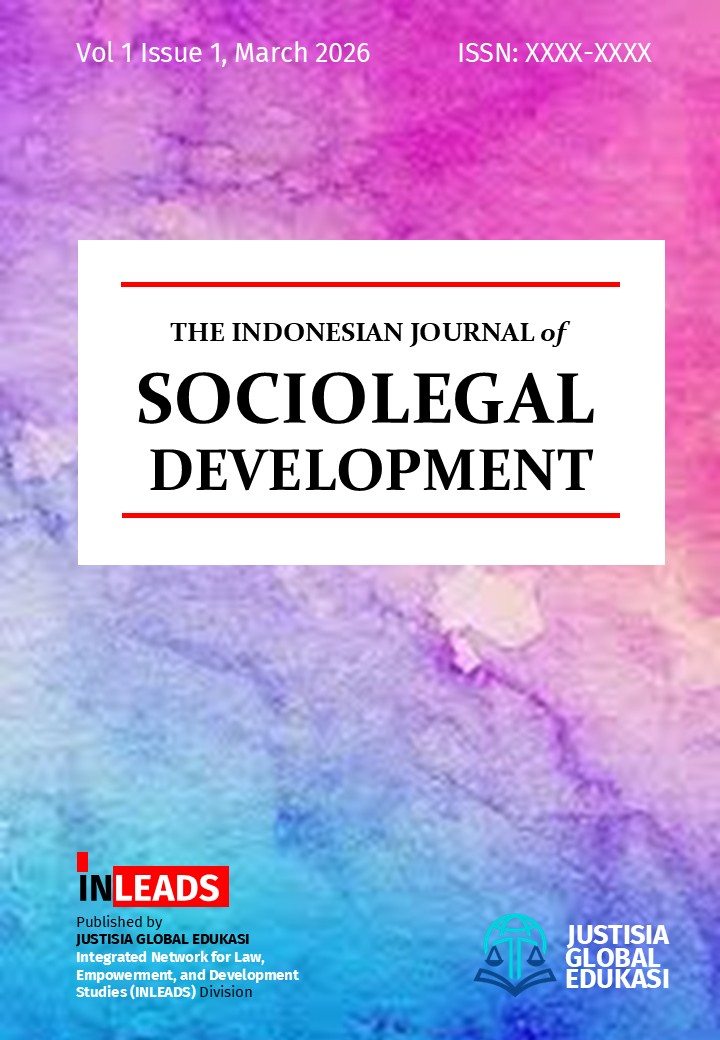
Access to Justice for Coastal Communities Affected by Reclamation Projects in Indonesia
Keywords:
Access to Justice, Coastal Communities, Reclamation Projects, Environmental Governance, Sociolegal StudiesAbstract
Coastal reclamation projects have become an important component of Indonesia’s infrastructure and urban development agenda. However, these projects frequently generate social, environmental, and legal challenges for coastal communities whose livelihoods depend on marine and coastal resources. This study analyzes access to justice for coastal communities affected by reclamation projects in Indonesia through a sociolegal perspective. Employing qualitative sociolegal methods, the research examines the extent to which affected communities can participate in decision-making processes and seek remedies for perceived harms. The findings reveal that access to justice is often constrained by limited legal knowledge, unequal bargaining power, procedural complexities, and restricted access to legal representation. Environmental impact assessments and public consultation mechanisms frequently fail to provide meaningful participation opportunities for local residents. As a result, communities encounter difficulties in protecting their economic interests, cultural identity, and environmental rights. The study further demonstrates that legal frameworks governing reclamation projects contain important procedural safeguards, yet their implementation remains inconsistent across different regions. Strengthening community participation, legal aid services, and transparency in development planning can significantly improve access to justice outcomes. The research argues that sociolegal approaches are necessary to understand the broader social impacts of reclamation policies beyond formal legal compliance. The study concludes that ensuring equitable access to justice requires integrating human rights principles, environmental governance, and community empowerment into coastal development policies. Such measures are essential for achieving sustainable development while safeguarding the rights and welfare of affected coastal populations.
References
Ansell, Chris, and Alison Gash. 2008. “Collaborative Governance in Theory and Practice.” Journal of Public Administration Research and Theory 18 (4): 543–571.
Arnstein, Sherry R. 1969. “A Ladder of Citizen Participation.” Journal of the American Institute of Planners 35 (4): 216–224.
Banakar, Reza, and Max Travers, eds. 2005. Theory and Method in Socio-Legal Research. Oxford: Hart Publishing.
Bedner, Adriaan. 2010. “An Elementary Approach to the Rule of Law.” Hague Journal on the Rule of Law 2 (1): 48–74.
Bennett, Nathan J., Jorge Blythe, Carole S. White, and Cathy Camillo Camargo. 2019. “Blue Growth and Blue Justice: Ten Risks and Solutions for the Ocean Economy.” Marine Policy 99: 172–179.
Berkes, Fikret. 2018. Sacred Ecology. 4th ed. New York: Routledge.
Biermann, Frank, and Philipp Pattberg. 2012. “Global Environmental Governance Reconsidered.” MIT Press.
Butt, Simon. 2014. Corruption and Law in Indonesia. New York: Routledge.
Cappelletti, Mauro, and Bryant Garth, eds. 1978. Access to Justice: A World Survey. Milan: Giuffrè.
Cotterrell, Roger. 1992. The Sociology of Law: An Introduction. 2nd ed. London: Butterworths.
Epp, Charles R. 1998. The Rights Revolution: Lawyers, Activists, and Supreme Courts in Comparative Perspective. Chicago: University of Chicago Press.
Escobar, Arturo. 2008. Territories of Difference: Place, Movements, Life, Redes. Durham, NC: Duke University Press.
Ewick, Patricia, and Susan S. Silbey. 1998. The Common Place of Law: Stories from Everyday Life. Chicago: University of Chicago Press.
Fabinyi, Michael. 2018. “Environmental Fixes and the Commodification of Nature in Coastal Southeast Asia.” Annals of the American Association of Geographers 108 (1): 35–47.
Fischer, Frank. 2000. Citizens, Experts, and the Environment: The Politics of Local Knowledge. Durham, NC: Duke University Press.
Fraser, Nancy. 2009. Scales of Justice: Reimagining Political Space in a Globalizing World. New York: Columbia University Press.
Galanter, Marc. 1974. “Why the ‘Haves’ Come Out Ahead: Speculations on the Limits of Legal Change.” Law & Society Review 9 (1): 95–160.
Griffiths, John. 1986. “What Is Legal Pluralism?” Journal of Legal Pluralism and Unofficial Law 18 (24): 1–55.
Harvey, David. 2003. The New Imperialism. Oxford: Oxford University Press.
Lemos, Maria Carmen, and Arun Agrawal. 2006. “Environmental Governance.” Annual Review of Environment and Resources 31: 297–325.
Lee, Maria, and Carolyn Abbot. 2003. “The Usual Suspects? Public Participation under the Aarhus Convention.” Modern Law Review 66 (1): 80–108.
Mason, Michael. 2018. “Environmental Democracy: Beyond the Liberal Paradigm.” Environmental Politics 27 (2): 207–227.
Merry, Sally Engle. 1988. “Legal Pluralism.” Law & Society Review 22 (5): 869–896.
Newig, Jens, and Maja Rose. 2020. “Guiding Principles for Effective Environmental Governance.” Environmental Policy and Governance 30 (4): 197–205.
Ostrom, Elinor. 1990. Governing the Commons: The Evolution of Institutions for Collective Action. Cambridge: Cambridge University Press.
Peluso, Nancy Lee, and Christian Lund. 2011. “New Frontiers of Land Control: Introduction.” Journal of Peasant Studies 38 (4): 667–681.
Sandefur, Rebecca L. 2008. “Access to Civil Justice and Race, Class, and Gender Inequality.” Annual Review of Sociology 34: 339–358.
Schlosberg, David. 2007. Defining Environmental Justice: Theories, Movements, and Nature. Oxford: Oxford University Press.
Sen, Amartya. 1999. Development as Freedom. New York: Alfred A. Knopf.
Susskind, Lawrence, and Jeffrey Cruikshank. 2006. Breaking Robert’s Rules: The New Way to Run Your Meeting, Build Consensus, and Get Results. Oxford: Oxford University Press.
Walker, Gordon. 2012. Environmental Justice: Concepts, Evidence and Politics. London: Routledge.
Downloads
Published
Issue
Section
License
Copyright (c) 2026 Sisilia Gunawan Saridevi, Tajuddin Ahmad Soleh Muhammad Ehsan (Author)

This work is licensed under a Creative Commons Attribution 4.0 International License.
All writings published in this journal are the personal views of the authors and do not represent the views of this journal and the author's affiliated institutions. Author(s) retain copyrights without any restriction under the license of a Creative Commons Attribution 4.0 International License (CC BY 4.0).